State Machines
Overview
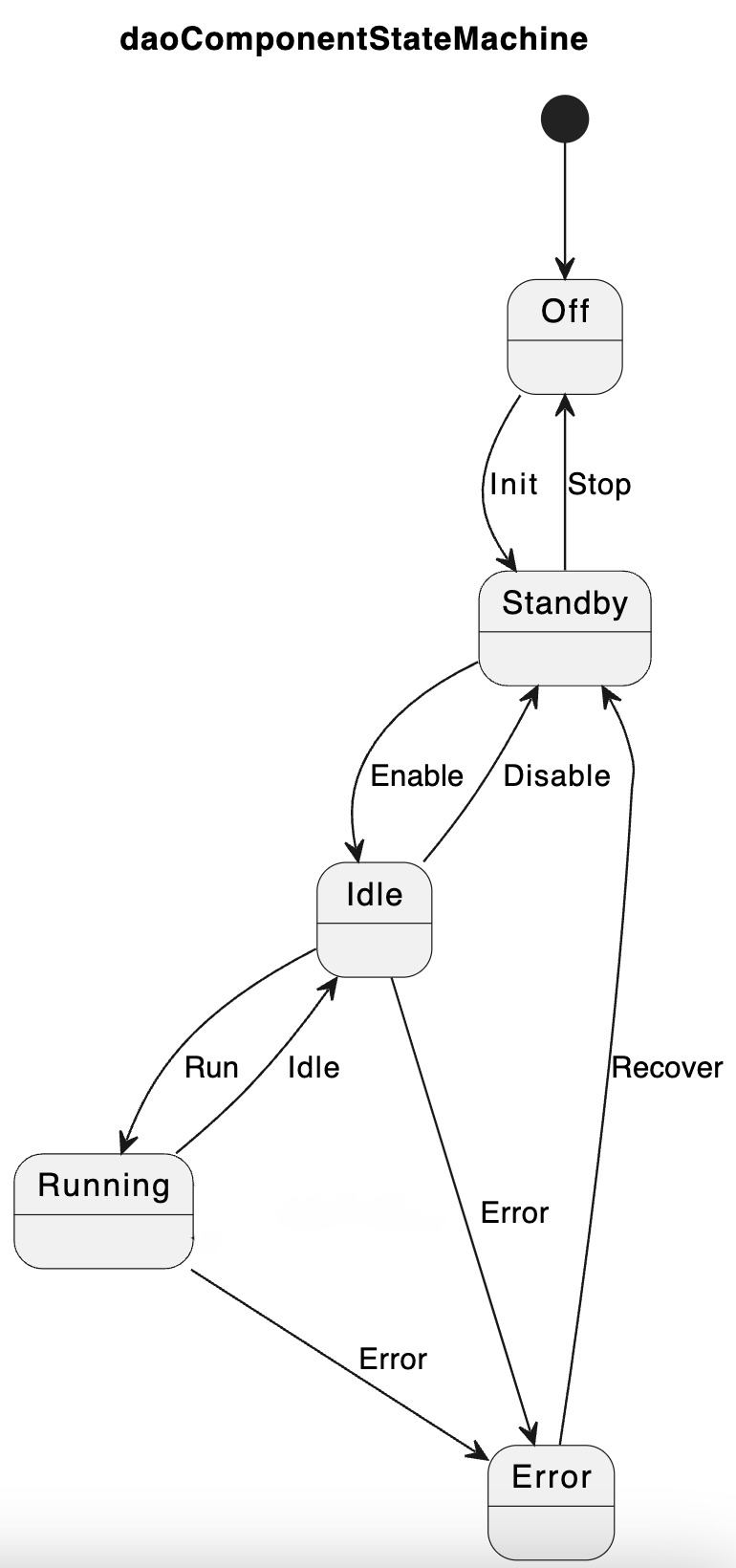
The Dao framework provides a C++ state machine class for implementing state-driven behavior in real-time applications. The state machine enforces a defined set of states and allowed transitions, validating all requested state changes. It supports user-defined entry, transition, and exit hooks for customizing behavior during state transitions.
States
Each state represents a distinct phase in the object’s lifecycle, with the state machine initially starting in the Off state. The table below lists the defined states and their respective meanings:
State |
Description |
|---|---|
Off |
The object is inactive. No initialization or configuration has taken place. |
Standby |
The object is now configured. |
Idle |
The object is ready to run but not actively processing yet. Resources are allocated at this stage. |
Running |
The object is actively performing its processing or task. |
Error |
The object encountered an error. |
Events
State transitions are initiated by posting events to the state machine using the
Dao::StateMachine::postEvent(Events event) method. This is a thread-safe
method and can thus be invoked concurrently from multiple threads; in the case of
multiple simultaneous events being posted, one will be carried out and the rest ignored.
Before performing a transition, the state machine validates whether the requested state change is permitted. If allowed, it invokes the exit hook of the current state, followed by the transition logic for this event, ending with the new state’s entry hook. However, if the transition is not permitted, then the request is simply ignored.
The state machine will catch any exceptions thrown by the current event’s hooks or transition function and will redirect the state from the requested state directly to the Error state to indicate a failure.
The table below summarizes the available events and the state transitions that they trigger.
Event |
Purpose |
|---|---|
Init |
Initialize the object from the Off state into Standby. |
Stop |
Stop operation and return to the Off state. |
Enable |
Transition from Standby to Idle, enabling the object for operation. |
Disable |
Transition from Idle to Standby, disabling operation. |
Run |
Transition from Idle to Running to start processing. |
Idle |
Transition from Running to Idle to stop processing. |
OnFailure |
Triggered when a failure occurs, transitioning to Error. |
Recover |
Attempt recovery from Error, transitioning to Idle. |
Custom Logic
Below are the available hooks and transitions that can be overridden by the user to implement custom logic during state transitions.
Hooks
void entry_Off() override;
void exit_Off() override;
void entry_Standby() override;
void exit_Standby() override;
void entry_Idle() override;
void exit_Idle() override;
void entry_Running() override;
void exit_Running() override;
void entry_Error() override;
void exit_Error() override;
Transitions
void transition_Off_Standby() override;
void transition_Standby_Off() override;
void transition_Standby_Idle() override;
void transition_Idle_Standby() override;
void transition_Idle_Running() override;
void transition_Running_Idle() override;
void transition_Idle_Error() override;
void transition_Running_Error() override;
void transition_Error_Idle() override;
Below is a code example that shows how to use the Dao C++ state machine class with custom behaviour for when the Idle state is entered and when the state changes from Idle to Running:
#include <daoComponent.hpp>

class MyComponent : public Dao::Component
{
public:
    MyComponent(std::string name, Dao::Log::Logger& logger,
                std::string ip, int port, int core = -1)
    : Component(name, logger, ip, port, core)
    {
        // Custom initialization
    }

protected:
    // Override state machine hooks
    void entry_Idle() override
    {
        // Custom idle state entry
        Component::entry_Idle();
    }

    void transition_Idle_Running() override
    {
        // Custom transition logic
        Component::transition_Idle_Running();
    }

private:
    // Component-specific members
};